
DBT Training and Certification: From Skills Training to Comprehensive DBT
Dialectical behavior therapy (DBT) is one of the most extensively studied psychotherapeutic approaches for borderline personality disorder (BPD). At the same time, the term “DBT training” does not refer to a single standardized course or qualification. Depending on the country, training provider and professional role, it may range from a short introductory workshop or DBT skills training to an intensive, team-based program designed to prepare clinicians to implement comprehensive DBT.
The training landscape also differs substantially between countries. In the United States, major DBT training programs are associated with Behavioral Tech and the Linehan Institute. In Europe, countries such as the United Kingdom, Ireland and Germany have developed their own training and accreditation structures. The DBT-Linehan Board of Certification (DBT-LBC) provides a formal individual certification pathway, while some European professional organizations operate their own accreditation systems.[7]
This guide explains what DBT training actually involves, how skills training differs from comprehensive DBT, how training pathways work in the United States and Europe, what certification means in different systems, and what clinicians should consider before choosing a DBT training program.
What Is DBT and Who Is It For?
Dialectical behavior therapy was developed by Marsha M. Linehan in the 1980s, initially for people with chronic suicidal behavior who met criteria for borderline personality disorder. The treatment integrates behavioral principles with acceptance-based strategies, mindfulness and dialectical thinking.[1]
The term dialectical is important here. In DBT, dialectics refers to working with apparently opposing positions and finding ways to integrate them rather than simply choosing one side. One of the central dialectics in treatment is the tension between acceptance and change: the therapist validates the patient’s current experience while simultaneously helping the patient develop behaviors that can improve their functioning and quality of life.
The strongest evidence base for DBT concerns borderline personality disorder, particularly problems involving suicidal behavior and self-harm. A 2024 systematic review of 18 randomized controlled trials involving 1,755 participants found that most included studies supported DBT’s effectiveness for BPD. Across studies, outcomes included suicidal ideation and behavior, self-injury, emergency service use, hospitalization, general psychopathology and depressive symptoms, although the authors also emphasized substantial methodological heterogeneity.[2]
Clinical guidelines also recognize DBT as an important treatment option for BPD. For example, NICE recommends considering a comprehensive DBT program for women with BPD when reducing recurrent self-harm is a priority.[13]
Over time, DBT has also been adapted for other clinical populations and problems involving severe emotion dysregulation, including substance use disorders, eating disorders and adolescent self-harm. However, the evidence base is not equally strong across all of these applications. DBT should therefore not be presented as having the same level of empirical support for every diagnosis or clinical problem.[2,3]
For clinicians working with diagnostic systems, DBT is particularly relevant to borderline presentations of personality pathology. In ICD-11, borderline pattern is specified as a qualifier that can be added to a diagnosis of personality disorder. This makes knowledge of DBT particularly relevant for clinicians working with patients who present with this pattern of difficulties.[4]
The Comprehensive DBT Model: Four Modes of Treatment
One of the most important distinctions in DBT training is the difference between skills training and comprehensive DBT.
DBT skills training is not synonymous with the full treatment model. In standard outpatient DBT, skills training is one of four treatment modes that work together within the comprehensive model.[1]
Individual therapy
Individual therapy is the central setting for treatment planning and behavioral analysis. The therapist works with a hierarchy of treatment targets, prioritizing life-threatening behaviors, followed by therapy-interfering behaviors and then behaviors that significantly interfere with quality of life.
Skills training
Skills training usually takes place in a group format and focuses on four core modules in the standard adult programme:
- Mindfulness
- Distress tolerance
- Emotion regulation
- Interpersonal effectiveness
The purpose is not simply to provide psychoeducation. Patients learn specific behavioral skills and are expected to practice and generalize them to everyday situations.
Phone coaching
Phone coaching is designed to help patients apply DBT skills in their natural environment, particularly when they are experiencing situations in which previously learned skills are difficult to use. It is not intended to function as an additional psychotherapy session.
Consultation team
The consultation team supports therapists rather than patients directly. Regular team consultation helps clinicians maintain adherence to the DBT model, address difficult clinical situations and sustain effective treatment delivery.
Comprehensive DBT therefore involves more than teaching DBT skills. Skills training is one component of the treatment system, whereas comprehensive DBT integrates all four modes.
DBT for Adolescents: The Fifth Skills Module
Everything described above refers primarily to the standard adult DBT model. Dialectical behavior therapy for adolescents (DBT-A), developed by Alec Miller and Jill Rathus with Marsha Linehan, retains the core structure of DBT while introducing several developmentally specific adaptations for adolescents and their families. One of the most distinctive changes is the addition of a fifth skills module: Walking the Middle Path.[16]
The adolescent adaptation was not designed simply as a shorter version of adult DBT. It modifies the treatment to address the developmental context of adolescence and the family system in which the young person lives. The model includes family involvement through components such as multifamily skills training, family therapy when needed, and parent-focused interventions. These adaptations are intended not only to help adolescents acquire new skills but also to improve communication and reduce polarized patterns of interaction between adolescents and their caregivers.[16,17]
What Is Walking the Middle Path?
Walking the Middle Path addresses problems that are particularly relevant to adolescent–family interactions. Rather than teaching adolescents to become simply “more flexible,” the module targets three distinct areas of skills:
- Dialectics – recognizing and integrating different perspectives instead of becoming stuck in either/or thinking.
- Validation – learning to acknowledge and communicate understanding of one’s own experience and the experience of others. In DBT-A, validation is taught as a bidirectional process between adolescents and caregivers.
- Behavior change principles – using behavioral principles such as reinforcement, shaping and extinction to promote more effective behaviors in oneself and others.
The module is based on the idea that adolescent–family difficulties can become organized around recurring dialectical dilemmas. Rathus and Miller identified three dilemmas that are particularly relevant to families of adolescents with significant emotional and behavioral difficulties.[16,17]
| One pole | The other pole | The dialectical dilemma |
|---|---|---|
| Excessive leniency | Authoritarian control | Being too permissive or too rigid with limits |
| Normalizing pathological behavior | Pathologizing normative behavior | Minimizing clinically significant problems or treating developmentally typical behavior as pathological |
| Forcing autonomy | Fostering dependence | Expecting independence prematurely or limiting opportunities to develop it |
The purpose of the module is not to find a simple compromise between the two extremes. Instead, the dialectical approach encourages adolescents, caregivers and therapists to recognize the validity of different perspectives and develop responses that integrate acceptance with effective behavioral change.[16]
How the Adolescent Model Differs From Adult DBT
The fifth module is added to the four core DBT skills modules rather than replacing any of them:
The adolescent adaptation therefore involves more than simply adding another set of worksheets. The way skills are taught, the involvement of caregivers and the family-focused components of treatment are all adapted to the developmental and interpersonal context of adolescence.[14,16]
DBT Skills Training vs. Comprehensive DBT
This distinction has direct implications for training.
A short course in DBT skills may be highly useful for clinicians who want to incorporate DBT skills into their existing clinical work or provide a structured skills-training program. It does not, however, automatically prepare someone to deliver comprehensive DBT.
Behavioral Tech explicitly describes skills training as one of the four modes of standard outpatient DBT and recommends comprehensive DBT Intensive Training for teams that want to implement a full DBT program.[5,6]
The distinction is also reflected in European training systems. British Isles DBT Training, for example, offers separate two-day DBT Skills Training: Essentials courses and more extensive Foundational and Intensive Training programs. The organization explicitly states that completing its introductory skills course does not qualify someone to conduct full DBT.[9]
For clinicians choosing a course, the question should therefore not simply be “Is this a DBT training?”, but rather:
What level of DBT competence is this training designed to develop?
DBT Training in the United States
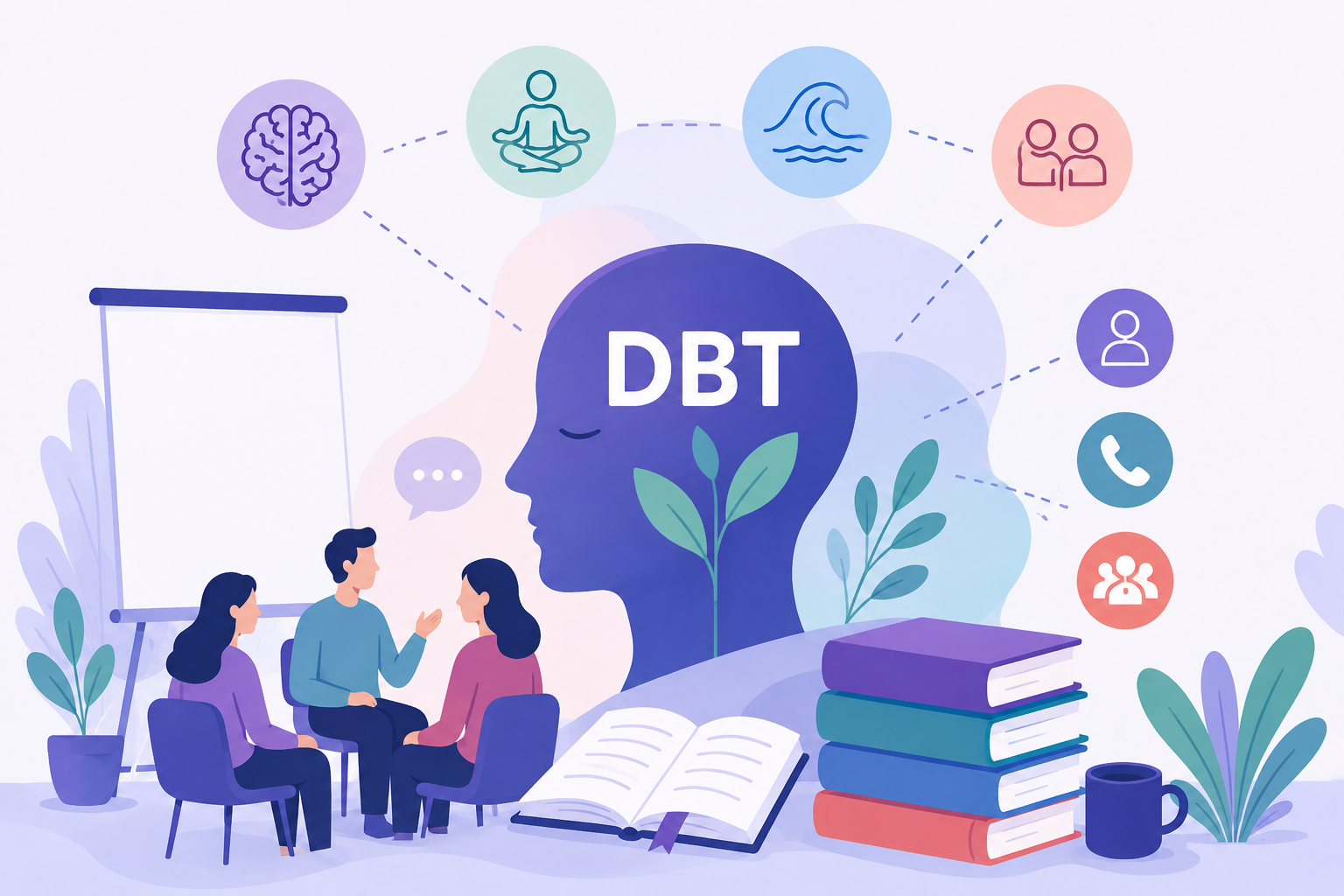
The United States is historically central to the development and dissemination of DBT. Marsha Linehan developed the treatment at the University of Washington, and Behavioral Tech became a major organization involved in disseminating DBT training.
One of the main advanced training formats offered by Behavioral Tech is DBT Intensive Training. It is described as a comprehensive, team-based program designed to provide clinicians with the knowledge and skills necessary to implement standard DBT. The standard format includes 60 hours of instructional training, typically delivered in two separate training periods spread across approximately 6–12 months.[5]
The training covers the theoretical foundations of DBT, case conceptualization, treatment structure, clinical strategies, risk assessment and management, skills training and procedures required to establish a DBT program. It is explicitly intended for teams rather than simply individual clinicians.[5]
This team-based structure is important. Comprehensive DBT was designed as a treatment system rather than simply a collection of techniques. Training an entire team makes it possible to establish the consultation structure and coordinate the different treatment modes.
Behavioral Tech also offers shorter skills-focused courses. These can be appropriate for professionals who want to develop competence in DBT skills without undertaking comprehensive team training.[6]
DBT Training in Europe
There is no single European DBT training system. Instead, different countries have developed their own professional organizations, training providers and accreditation structures.
This means that a clinician trained in the United Kingdom, Germany, Poland or another European country may encounter different terminology and requirements even when the underlying DBT model is based on the same Linehan tradition.
United Kingdom and Ireland
In the United Kingdom and Republic of Ireland, British Isles DBT Training (biDBT) is a major training provider affiliated with Behavioral Tech. The organization describes itself as the sole licensed DBT training provider in Great Britain and the Republic of Ireland and reports having trained thousands of professionals and supported the development of hundreds of DBT programs.[9]
Its current training catalogue illustrates the range of available training levels. These include:
- two-day DBT Skills Training: Essentials courses;
- five-day Dialectical Behaviour Therapy Foundational Training;
- five-day DBT Upgrade Training;
- ten-day DBT Intensive Training;
- specialist courses for particular populations and clinical problems.
The UK and Ireland also have an independent professional accreditation system. The Society for DBT in the UK & Ireland (SfDBT) accredits DBT therapists and supervisors. Its therapist accreditation process requires, among other things, an appropriate core professional qualification, active DBT practice in the UK or Ireland and completion of the Society’s accreditation process.[8]
This creates an important distinction between training and accreditation: completing a training course is not necessarily the same as becoming an accredited DBT therapist.
Germany
Germany provides another example of a more formal national certification structure. The Dachverband DBT e.V. has defined requirements for certification as a DBT therapist.
The current requirements include professional licensure as a psychotherapist or appropriate medical qualification, 96 hours of DBT theoretical training, a supervised outpatient case lasting at least one year, participation in a DBT consultation team, a supervision workshop, a supervised skills group, a supervisor recommendation, a case conceptualization and an examination.[10]
This illustrates why “DBT certification” should not be treated as a single international credential. The requirements depend on the certification body and country.
DBT Training in Poland
Poland represents another national model within the broader European DBT landscape.
The Polish Association for Dialectical Behavior Therapy (Polskie Towarzystwo Terapii Dialektyczno-Behawioralnej, PTDBT) organizes DBT training, consultation teams and professional development activities. Its current DBT Comprehensive 2026–2027 program consists of 110 hours of didactic training combined with consultation-team work and mentoring.[8]
The program is primarily aimed at professionals with substantial clinical or psychotherapy training and is structured around team-based implementation.
For Polish clinicians, the important point is that completing a PTDBT training program should not automatically be interpreted as equivalent to obtaining an international DBT certification. Poland does not have a statutory national DBT certification system comparable to the accreditation structures operating in some other European countries.
The Polish pathway is therefore best understood as one national training route within the broader international DBT ecosystem.
The table below summarises how the routes described above differ from one another.
| Country or region | Training organization | Example advanced format | Certification or accreditation route |
|---|---|---|---|
| United States | Behavioral Tech | DBT Intensive Training: 60 instructional hours delivered in two periods across roughly 6–12 months, addressed to teams rather than individual clinicians | DBT-Linehan Board of Certification (DBT-LBC), an international route open to independently licensed practitioners |
| United Kingdom and Ireland | British Isles DBT Training (biDBT), affiliated with Behavioral Tech | Ten-day DBT Intensive Training; five-day Foundational Training; two-day skills courses | Society for DBT in the UK & Ireland (SfDBT) accredits therapists and supervisors; training alone does not make a therapist accredited |
| Germany | Dachverband DBT e.V. | 96 hours of DBT theoretical training | National certification requiring licensure, a supervised outpatient case lasting at least a year, consultation team, supervision workshop, supervised skills group, case conceptualization and an examination |
| Poland | Polish Association for Dialectical Behavior Therapy (PTDBT) | DBT Comprehensive 2026–2027: 110 hours of didactic training with consultation-team work and mentoring | No statutory national certification system; the international DBT-LBC route remains available |
Read the table by column, not by row. The training format and the credential are separate questions in every country listed. A clinician can complete the most advanced programme available locally and still not hold a certification, because certification bodies additionally assess supervised clinical work, consultation-team participation and demonstrated competence.
Does Completing DBT Training Make You a Certified DBT Therapist?
Not necessarily.
Training and certification are separate concepts.
A clinician may complete a two-day DBT skills course, a five-day foundational course or a longer comprehensive training program without automatically becoming a formally certified or accredited DBT therapist.
One important formal certification pathway is provided by the DBT-Linehan Board of Certification (DBT-LBC). Applicants for individual certification must be independently licensed mental health practitioners with an unrestricted professional license. They must also document at least 40 hours of DBT-specific didactic training, among other requirements.[7]
The DBT-LBC process also places importance on actual clinical practice and participation in a DBT consultation team. Its application materials require evidence of active participation in a consultation team for at least one year.[7]
This is important because certification is therefore not simply a matter of accumulating classroom hours.
Training → supervised clinical practice → consultation → demonstrated competence → accreditation/certification
The exact requirements vary by certification body.
Why Consultation Teams Matter
Consultation teams are one of the features that distinguish comprehensive DBT from many short-form training programs.
DBT was designed to support therapists working with patients who may present with severe emotion dysregulation, self-harm, suicidality and complex interpersonal difficulties. Regular consultation provides a structured environment in which therapists can examine their clinical work, maintain adherence to the treatment model and receive support.
This is also reflected in accreditation systems. For example, the UK Society for DBT requires ongoing professional development and consultation as part of advanced DBT practice, while the German certification pathway includes participation in a DBT consultation team as a formal requirement.[8,10]
For this reason, a training program that offers only lectures and a certificate of attendance should not be assumed to provide the same level of preparation as a team-based program with ongoing consultation and supervised clinical practice.[15]
ACT as a Contrast: Training Without Formal Therapist Certification
A useful comparison is Acceptance and Commitment Therapy (ACT).
ACT is a transdiagnostic behavioral therapy developed within the broader field of Contextual Behavioral Science (CBS). One of the main international organizations associated with this field is the Association for Contextual Behavioral Science (ACBS).
The certification structure is fundamentally different from DBT.
ACBS does not offer an official certification for ACT therapists. The organization explicitly states that there is no such thing as an officially certified ACT therapist. Instead, ACBS maintains an open professional community and promotes quality through training, competency resources and a peer-review system for ACT trainers.[11]
The Peer-Reviewed Trainer (PRT) designation applies to trainers, not clinicians. ACBS explicitly states that the PRT process is not an accreditation or certification of clinical competence and does not determine whether someone is competent to practice ACT as a therapist.[12]
For clinicians learning ACT, this means that a certificate issued after attending a commercial ACT workshop should not be confused with an official ACBS certification—because no such therapist certification exists.
Other Specialized Approaches
DBT and ACT are not the only structured psychotherapy approaches with dedicated training pathways.
Schema Therapy has an international certification system developed by the International Society of Schema Therapy (ISST). EMDR also has formal training and accreditation structures, including standards developed through EMDR Europe.
Other approaches, including Compassion-Focused Therapy (CFT), Mentalization-Based Treatment (MBT) and Internal Family Systems (IFS), have different educational and professional structures depending on the country and organization providing the training.
These approaches should not be placed on a simple scale of “easy” versus “difficult” to enter. Their training hours, prerequisites, supervised practice, accreditation systems and professional requirements are not directly equivalent.
The more useful question is:
What level of training, supervised practice and demonstrated competence does a particular professional body require before a clinician can claim advanced competence in that approach?
How Much Does DBT Training Cost?
The cost of DBT training varies considerably depending on the country, training level and provider.
In the United States, comprehensive team-based training is generally substantially more expensive than short skills workshops because it includes multiple training periods, consultation and implementation support. Behavioral Tech’s standard DBT Intensive Training is a 60-hour program delivered over two training periods separated by approximately 6–12 months.[5]
In the United Kingdom and Ireland, current examples illustrate the range. British Isles DBT Training lists two-day DBT Skills Training: Essentials courses at £400 + VAT, while five-day Foundational Training is currently listed at £1,050 plus a £70 license fee and VAT. More advanced training is considerably more expensive.[9]
International courses are also offered in euros. For example, British Isles DBT Training currently lists international five-day DBT Foundational Training at €1,050 plus VAT and an €80 license fee.[9]
| Course | Length | Price as listed |
|---|---|---|
| DBT Skills Training: Essentials (biDBT) | two days | £400 + VAT |
| Foundational Training (biDBT) | five days | £1,050 + £70 license fee + VAT |
| International Foundational Training (biDBT) | five days | €1,050 + €80 license fee + VAT |
These prices should be treated as examples rather than universal costs. A realistic budget may also need to include:
- supervision;
- consultation-team participation;
- travel and accommodation;
- professional membership fees;
- books and training materials;
- continuing professional development;
- examination or accreditation fees.
The total cost of becoming competent in DBT is therefore substantially higher than the registration fee for a single introductory workshop.
How to Choose a DBT Training Program
Before enrolling in a DBT training program, it is worth checking several factors.
- Scope of training. Does the course cover DBT skills only, foundational DBT, or comprehensive DBT?
- Training provider. Is the provider affiliated with a recognized DBT organization or experienced training network?
- Trainer qualifications. Can the trainers’ clinical and training experience be independently verified?
- Prerequisites. Is the course intended for psychologists, psychiatrists, nurses, social workers, psychotherapists or other professionals?
- Clinical practice. Does the program include supervised clinical work?
- Consultation. Will you have access to an ongoing DBT consultation team?
- Assessment. Is there an examination, competency assessment or evaluation of clinical work?
- Credential. Will you receive a certificate of attendance, a training certificate, national accreditation or eligibility for an independent certification process?
- Implementation support. If the goal is to establish a comprehensive DBT program, does the training support the development of a functioning clinical team?
- Total cost. Consider supervision, consultation, travel, materials and accreditation fees in addition to the course fee.
A particularly important warning sign is a training provider that presents a short course certificate as equivalent to formal DBT therapist certification.
Training Is Not the Same as Competence
The growing availability of DBT workshops makes it increasingly important to distinguish exposure to DBT concepts from clinical competence in DBT.
A two-day course can provide a useful introduction to the four skills modules. A foundational program can provide a substantially deeper understanding of DBT strategies and treatment structure. Comprehensive training adds team-based implementation, consultation and more extensive clinical preparation.
Formal certification or accreditation goes one step further by requiring evidence that the clinician has not only attended training but has met defined professional and clinical requirements.
This distinction is consistent with the broader principle that psychotherapy training should include appropriate supervision and support. NICE, for example, recommends routine access to supervision and staff support for mental health professionals working with people with BPD.[13]
A Practical DBT Training Pathway
Although there is no single global pathway, a clinician’s development can often be understood as a sequence:
- Introduction to DBT. Learn the theoretical foundations, treatment philosophy and basic DBT strategies.
- Skills training. Develop competence in mindfulness, distress tolerance, emotion regulation and interpersonal effectiveness.
- Foundational or comprehensive training. Study the full treatment model, behavioral assessment, treatment hierarchy, case conceptualization and DBT strategies.
- Consultation and supervised clinical practice. Work with actual patients while receiving regular consultation and supervision.
- Competency development. Demonstrate the ability to implement DBT with appropriate adherence to the model.
- Accreditation or certification. Where available, apply for the relevant national or international certification pathway.
The exact sequence varies by country. In the United Kingdom and Ireland, for example, the Society for DBT provides a formal therapist accreditation process, while Germany has its own certification requirements through Dachverband DBT. In the United States, DBT-LBC provides an individual certification pathway with defined professional, training and clinical requirements.
A Diagnostic Perspective
Choosing a psychotherapy approach should ultimately be informed by the clinical population, the patient’s needs and the therapist’s competencies rather than by the popularity of a particular training program.
For DBT, particularly relevant clinical knowledge includes borderline personality disorder, suicidal behavior, self-harm and severe difficulties with emotion regulation. At the same time, a diagnosis alone should not automatically determine treatment selection. Clinical severity, treatment goals, patient preferences, available support and the therapist’s competence should also be considered. NICE similarly emphasizes considering factors such as severity, treatment preferences, motivation and available professional support when selecting psychological treatment for BPD.[13]
For clinicians working within ICD-11, understanding the borderline pattern qualifier can provide an additional framework for identifying patients who may benefit from approaches such as DBT.[4]
Summary
DBT training is not a single standardized qualification. Around the world, clinicians can encounter different levels of training, from introductory skills workshops to intensive team-based programs designed to implement comprehensive DBT.
The most important distinction is between learning DBT skills and being trained to deliver comprehensive DBT. Skills training represents one mode of the treatment, whereas comprehensive DBT integrates individual therapy, skills training, phone coaching and therapist consultation.
The United States remains central to DBT training through organizations associated with the Linehan tradition and Behavioral Tech. European countries have developed additional national training and accreditation structures, including formal therapist accreditation in the United Kingdom and Ireland and certification through Dachverband DBT in Germany. Poland has its own developing training infrastructure through PTDBT.
For clinicians considering advanced training, the key question is therefore not simply “Where can I get a DBT certificate?” but:
What training, supervised practice, consultation and competency assessment are required for me to deliver DBT safely and with fidelity to the model in the country where I practice?
That distinction is essential when evaluating DBT training programs—and when interpreting what a certificate actually represents.
Frequently Asked Questions
Do I need to be a psychotherapist to take DBT training?
Is a two-day DBT skills course enough to become a DBT therapist?
How many hours of DBT training are required for certification?
Is DBT certification international?
Does DBT Comprehensive mean the same thing everywhere?
Does ACBS certify ACT therapists?
What should I look for in a high-quality DBT training program?
References
- Linehan, M. M. (1993). Cognitive-Behavioral Treatment of Borderline Personality Disorder. Guilford Press. guilford.com (accessed: 14.08.2026).
- Hernandez-Bustamante, M., Cjuno, J., Hernández, R. M., & Ponce-Meza, J. C. (2024). Efficacy of dialectical behavior therapy in the treatment of borderline personality disorder: A systematic review of randomized controlled trials. Iranian Journal of Psychiatry, 19(1), 119–129.
- Storebø, O. J., et al. (2020). Psychological therapies for people with borderline personality disorder. Cochrane Database of Systematic Reviews.
- World Health Organization. ICD-11 for Mortality and Morbidity Statistics: 6D10 Personality Disorder. icd.who.int (accessed: 14.08.2026).
- Behavioral Tech Institute. Dialectical Behavior Therapy Intensive Training. behavioraltech.org/training (accessed: 14.08.2026).
- Behavioral Tech Institute. Training Catalog: DBT Skills Training and Intensive Training. behavioraltech.org (accessed: 14.08.2026).
- DBT-Linehan Board of Certification. Individual Certification Requirements. dbt-lbc.org (accessed: 14.08.2026).
- Society for Dialectical Behaviour Therapy UK & Ireland. Therapist Accreditation. sfdbt.uk (accessed: 14.08.2026).
- British Isles DBT Training. DBT Training Courses and Foundational Training. bidbt.co.uk (accessed: 14.08.2026).
- Dachverband DBT e.V. DBT Therapist Certification Requirements. dachverband-dbt.de (accessed: 14.08.2026).
- Association for Contextual Behavioral Science. ACT Certification. contextualscience.org (accessed: 14.08.2026).
- Association for Contextual Behavioral Science. Peer-Reviewed ACT Trainer Process. contextualscience.org/training_standards (accessed: 14.08.2026).
- NICE. Borderline Personality Disorder: Recognition and Management – Recommendations. nice.org.uk/guidance/cg78 (accessed: 14.08.2026).
- NICE. Self-harm: Assessment, Management and Preventing Recurrence. nice.org.uk/guidance/ng225 (accessed: 14.08.2026).
- British Psychological Society. Benchmarks for dialectical behavioural therapy intervention in adults and adolescents with borderline personality symptoms. bps.org.uk (accessed: 14.08.2026).
- Rathus, J. H., & Miller, A. L. (2015). DBT Skills Manual for Adolescents. Guilford Press. (source of the Walking the Middle Path module)
- Rathus, J. H., Campbell, B., Miller, A. L., & Smith, H. (2015). Treatment Acceptability Study of Walking the Middle Path, a New DBT Skills Module for Adolescents and Their Families. American Journal of Psychotherapy, 69(2), 163–178. pubmed.ncbi.nlm.nih.gov/26160621 (accessed: 15.08.2026).