

SCID-5-CV vs. SCID-5-PD: Which Interview to Choose, Where to Train and What It Costs
SCID-5 is not one interview. It is a series of instruments built on the same logic and aimed at different diagnostic questions: SCID-5-CV for clinical disorders, SCID-5-PD for categorical personality disorders and SCID-5-AMPD for the dimensional assessment of personality pathology. Which one you need, who is allowed to administer it, what training actually prepares you to use it and what the whole thing costs all differ from country to country – there is no single global rulebook. This guide maps the series, the access rules across Europe and the US, the training market and the point where DSM-5 interviewing meets the dimensional ICD-11 personality model.[1,2,7]
What are the individual SCID-5 versions?
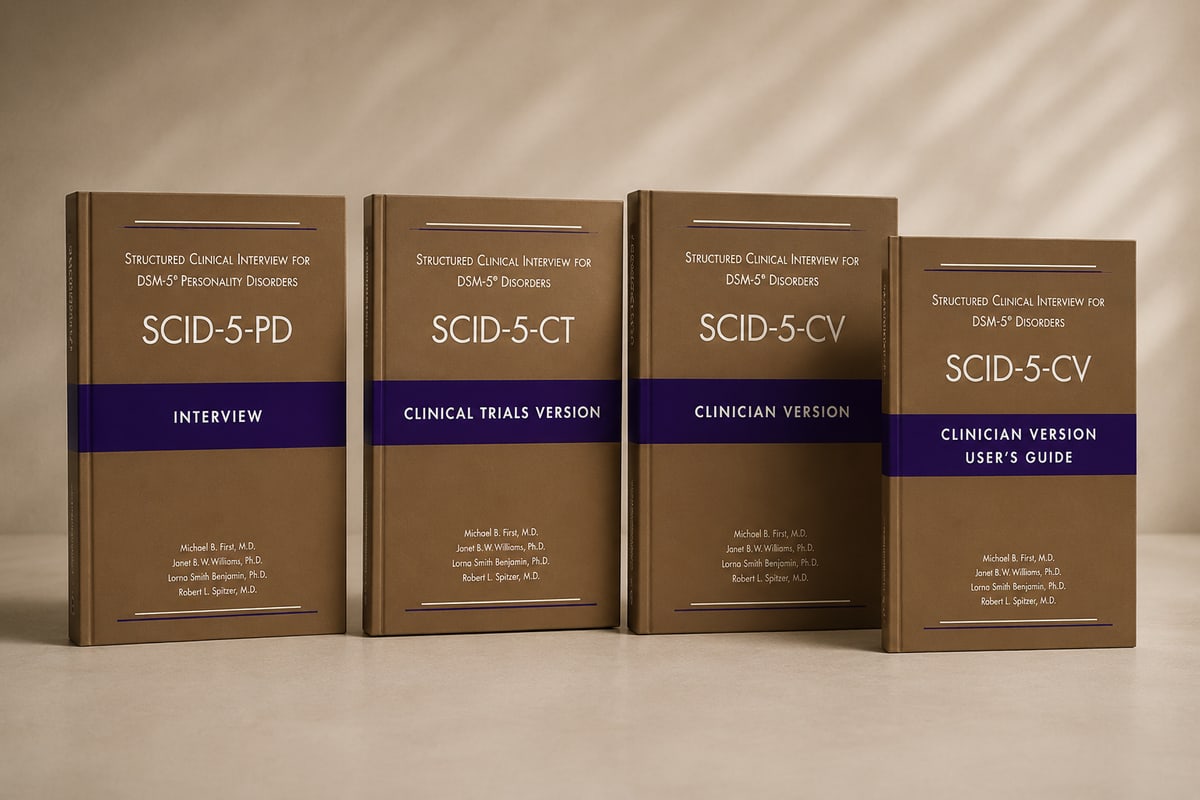
SCID-5 (Structured Clinical Interview for DSM-5) is a series of semi-structured clinical interviews developed under the direction of Michael B. First and colleagues, including Janet B. W. Williams and Robert L. Spitzer, and published by American Psychiatric Association Publishing. The series covers several versions: the research version SCID-5-RV, the clinician version SCID-5-CV, the clinical-trials version SCID-5-CT, the personality disorder interview SCID-5-PD, the alternative-model interview SCID-5-AMPD and the abbreviated QuickSCID-5.[1,2]
The principle is simple. Instead of an open clinical conversation whose content and order depend on the individual clinician, the interview walks the assessor through DSM-5 diagnostic criteria with standardised questions, branching rules and coding conventions. The semi-structured design deliberately leaves room for follow-up questions and clinical judgment, while reducing the risk that a relevant diagnostic area is simply never asked about – which is why the SCID family became a reference standard in psychiatric research. The classification the whole series rests on is covered separately in What is DSM-5?[1,2]
The SCID-5 interviews are intended to be administered by trained mental health professionals or researchers; what matters is clinical experience and familiarity with psychopathology rather than a specific academic degree.
American Psychiatric Association Publishing on the intended users of SCID-5 – paraphraseDistribution is international but not uniform. APA Publishing is the publisher of the original English instruments; authorised translations are handled by national publishers, professional associations or licensed distributors, which means the available version, the purchase route, the professional requirements and the price can all differ by country.[1,3]
SCID-5-CV: the clinician version
SCID-5-CV (Structured Clinical Interview for DSM-5 Disorders – Clinician Version), authored by First, Williams, Karg and Spitzer, covers the DSM-5 clinical disorders most often encountered in everyday practice. Its modules span mood disorders, psychotic symptoms and the differential between psychotic and mood presentations, substance use disorders, anxiety disorders, obsessive-compulsive disorder and PTSD, adult ADHD, a screen for further conditions and adjustment disorders.[3,4]
Modularity is the practical point. The interview does not have to be administered end to end: a clinician working mainly with affective presentations can use only the relevant modules, and in several markets individual modules are also sold separately. That flexibility is what makes SCID-5-CV usable in a normal appointment slot rather than only in a research protocol.[3,4]
SCID-5-CV is a semi-structured interview guiding the clinician through the DSM-5 diagnoses most commonly seen in practice; publishers list its use in inpatient psychiatric settings, forensic contexts, research and teaching.
Publisher descriptions of SCID-5-CV – paraphraseWhat does SCID-5-CV cost?
There is no single worldwide price. Cost depends on country, distributor, language edition, format, tax treatment and whether the user guide is bought alongside the interview booklet. As reference points: US retail listings place the clinician booklet at roughly USD 85–90, while a complete localised package sold by a national distributor sits higher – the Polish edition, for instance, runs at about PLN 1,095 gross for the full set, with individual modules from roughly PLN 29 to PLN 148. Treat both as market examples, not as a universal SCID-5 price.[1,3]
SCID-5-PD: ten personality disorders plus a fast screen
SCID-5-PD (Structured Clinical Interview for DSM-5 Personality Disorders), by First, Williams, Benjamin and Spitzer, is the successor to the widely used SCID-II. It assesses the ten DSM-5 personality disorders grouped in Clusters A, B and C, plus other specified personality disorder.[5]
Its structural advantage is the two-stage design. Assessment normally opens with the SCID-5-SPQ screening questionnaire, which takes around 20 minutes to complete; the interview proper is then conducted only in the areas the screen flags. The interview is designed for adults, administered individually, and used internationally in clinical, forensic, research and teaching contexts – with the caveat that permissible contexts follow national regulation and professional standards rather than the publisher's catalogue.[5]
On price, SCID-5-PD is usually the cheapest entry point into the series, since the screening questionnaire and a shorter interview booklet replace the ten-module apparatus of the clinician version. Prices for translated editions are not directly comparable across markets, because they reflect different licensing, adaptation and distribution arrangements – for any other country, the authoritative figure is the current APA Publishing or authorised distributor listing for that language edition.[1,5]
SCID-5-AMPD: functioning and traits – closest to ICD-11 logic
SCID-5-AMPD (Structured Clinical Interview for the DSM-5 Alternative Model for Personality Disorders), by First, Skodol, Bender and Oldham, is built on the alternative model published in Section III of DSM-5. It comprises three modules: Module I rates the level of personality functioning (identity, self-direction, empathy, intimacy), Module II covers pathological personality traits, and Module III allows an additional categorical diagnosis.[6]
This is the version worth knowing for one specific reason. Structurally it is the closest of the three to the dimensional logic later adopted in ICD-11, where a personality disorder diagnosis rests on the severity of dysfunction with optional trait qualifiers rather than on classical types. A clinician who wants to think dimensionally about personality gets a rating structure for functioning and traits that neither the categorical SCID-5-PD nor a self-report questionnaire provides. It remains, however, a DSM-5 instrument – not an ICD-11 interview.[6,7]
CV, PD or AMPD – which interview should you choose?
The answer follows the diagnostic question. Choose SCID-5-CV when the assessment concerns clinical disorders – depression, anxiety, psychosis, substance use – and their differential diagnosis. Choose SCID-5-PD when the question is whether a patient meets criteria for a specific DSM-5 personality disorder. Choose SCID-5-AMPD when the goal is a dimensional picture: level of personality functioning plus pathological traits, in terms that travel more comfortably towards the ICD-11 model (6D10).[3,5,6]
| Criterion | SCID-5-CV | SCID-5-PD | SCID-5-AMPD |
|---|---|---|---|
| Primary focus | DSM-5 clinical disorders in modules (mood, psychosis, anxiety, OCD/PTSD, substances, adult ADHD, adjustment and others) | Ten DSM-5 personality disorders (Clusters A, B, C) plus other specified | Level of personality functioning + pathological traits + categorical module |
| Framework | DSM-5, mainly categorical | DSM-5, categorical | DSM-5 Alternative Model, dimensional |
| Assessment structure | Modular; sections chosen to fit the question | SPQ screen (about 20 min) then the flagged sections | Three modules, no fixed time limit |
| Typical use | Diagnosis and differential diagnosis, inpatient settings, research, teaching | Categorical personality disorder assessment; clinical, forensic and research contexts | Dimensional personality assessment and research |
| Direct ICD-11 instrument? | No | No | No, though conceptually closest to ICD-11 |
CV and PD are also complementary in practice. A patient may meet criteria for personality pathology while presenting with a depressive, anxiety or substance-related disorder at the same time, and a full formulation may draw on both interviews. For working through competing clinical pictures, our differential diagnosis module covers the same ground from the ICD-11 side.[3,5]
Who may use SCID-5? Access rules differ by country
The single most important point for an international reader: there is no worldwide licensing rule that defines who may administer SCID-5. APA Publishing describes the interviews as instruments for trained mental health professionals and researchers. Everything else – purchasing categories, professional eligibility, supervision expectations – is set nationally.[1,8]
That produces a distinction worth stating plainly: being able to buy an interview is not the same as being prepared to administer it. In some markets a clinician can obtain a copy with no training whatsoever, while a research institution in the same country may require documented interviewer training, rated practice interviews and ongoing supervision before anyone is allowed to code a single case.[8,9]
Purchase eligibility is a commercial and regulatory question. Competence to conduct a semi-structured diagnostic interview is a clinical one, and the two are decided by different bodies.
Summary of publisher and national access rulesUnited States
US distribution runs through American Psychiatric Association Publishing. Arrangements differ by version: the clinician version is commercially published, while the research version SCID-5-RV and the clinical-trials version SCID-5-CT involve additional licensing, and permissions are required for reproduction or translation. For clinical use the operative question is not purchase access but whether the professional has the training to administer and interpret a semi-structured interview.[1,9]
Europe
European access is not harmonised. Some countries work with the original English instruments; others use authorised translations distributed by national publishers or professional associations, each with its own purchasing conditions. Professional eligibility follows national regulation of psychology, psychiatry and psychotherapy, which varies widely across the EU and EEA – a title that is protected and state-regulated in one member state may be unregulated in another.[3,8]
Poland is a useful illustration of how local classifications work: the Psychological Test Laboratory of the Polish Psychological Association places the Polish SCID-5 editions in its Category A, which allows relatively broad purchase access compared with restricted psychometric tests such as MMPI-2. This is a national purchasing classification, not an international SCID standard, and it says nothing about competence.[3,8]
In the United Kingdom, clinicians and researchers access SCID-5 through the publisher and authorised training channels, with additional requirements determined by professional registration, the employing service and the intended use.[10]
Other regions
SCID-5 is used well beyond North America and Europe, wherever DSM-5 features in clinical research. Before buying or using it in another jurisdiction it is worth checking four things: whether an authorised local-language version exists; who holds the distribution or translation rights; whether the national professional body imposes additional requirements; and whether the intended use is clinical, research or educational, since the licensing route differs.[1,9]
SCID-5 training: what it actually means, and what it costs

There is no worldwide SCID-5 certification comparable to a licensing examination. Training is delivered by universities, research groups, hospitals, professional associations and private providers, and the label covers everything from a two-hour introductory webinar to a research interviewer-qualification programme with reliability checks.[9,10]
Official educational materials come from the Columbia University Biometrics Research Program, which maintains the SCID training resources, including a multi-hour SCID-5-101 webinar and reference interview recordings licensed to individuals or institutions. Those licences sit at a different price point from a one-day commercial workshop, and they serve a different purpose: standardising administration rather than introducing the instrument.[9]
A programme worth paying for normally covers the structure of the specific version, the diagnostic criteria and decision rules, interviewing technique, handling of ambiguous or contradictory answers, differential diagnosis, coding and documentation, supervised case work, and feedback on actual practice interviews.[9,10]
| Market | Example | Approximate cost |
|---|---|---|
| United States | SCID-5-CV clinician booklet (retail listing) | USD 85–90 |
| United States | SCID-5-101 webinar licence, Columbia Biometrics Research | Individual and institutional licence tiers |
| United Kingdom | Three-day SCID-5-AMPD training with follow-up supervision | around £850 |
| Central Europe | One-day online SCID-5 course, commercial or university provider | equivalent of roughly EUR 140–180 |
These are listed examples for specific courses and dates, not standing international rates. The full cost of becoming competent is usually higher than the course fee, because it also absorbs supervision, the instrument itself in the relevant language edition, institutional licensing where research use is planned, and travel where the training is in person. The cheapest workshop is rarely the most cost-effective route.[9,10]

SCID-5 and dimensional personality diagnosis in ICD-11
ICD-11 reorganised personality disorder from the ground up. Instead of types such as paranoid or histrionic personality, diagnosis rests on severity – from personality difficulty (QE50.7) through mild and moderate to severe personality disorder (6D10.x) – with optional qualifiers for five trait domains (negative affectivity, detachment, dissociality, disinhibition, anankastia) and a borderline pattern qualifier. The model is covered in detail in Personality disorders in ICD-11.[7,11]
In ICD-11 the classical personality disorder categories were replaced by a rating of the severity of personality dysfunction, supplemented by qualifiers for dysfunctional trait domains – a change of paradigm rather than a relabelling of the ICD-10 categories.
Peer-reviewed accounts of the ICD-11 personality model – paraphraseThe practical consequence is that no SCID-5 version outputs an ICD-11 diagnosis. SCID-5-PD returns a categorical DSM-5 result; SCID-5-AMPD returns a rating of personality functioning and traits that maps more naturally onto severity-plus-domains thinking but is still Alternative Model output. Where a dimensional instrument is wanted, questionnaires such as PID-5 and the PiCD (Personality Inventory for ICD-11) are the usual companions in research and practice, with validation studies published across several languages.[11,12,13]
For a clinician working in an ICD-based health system, the workable setup is therefore two-part: a structured DSM-5 interview to collect the clinical information reliably, and separate familiarity with the ICD-11 model to express the result in the language of severity and trait domains. Data collection and classification are different skills, and conflating them is where most of the confusion comes from.[7,11]
Checklist: choosing an interview and a training programme
A practical list to run through before buying an instrument or booking a course:
- Define the diagnostic question – clinical disorders and differential diagnosis (CV), categorical personality disorder (PD), or dimensional personality assessment (AMPD)?
- Check access in your own jurisdiction – publisher conditions, the authorised distributor for your language edition, and what your professional regulator and employer require.[1,8]
- Confirm the edition is authorised – a PDF circulating online is not an authorised version; translations and reproductions require permission from the publisher.[1]
- Budget the instrument, not just the course – manual, interview forms and, for CV, the option of buying only the modules matching your caseload.[3,5]
- Match the training to the version – a SCID-5-CV course does not prepare you for SCID-5-PD, and neither prepares you for the AMPD rating logic.[9]
- Weigh practice over hours – case work, role-play and feedback on recorded interviews matter more than the length of the lecture block.[9,10]
- Ask what the certificate confirms – attendance, continuing-education hours or assessed competence; for research use, ask specifically about reliability checks.[9]
- Plan the bridge to ICD-11 – if you report in ICD-11, pair the interview with training in the dimensional model and describe categorical findings in severity and trait-domain terms as well.[7,11]
For everyday work with ICD-11 criteria – including translating DSM-5 findings from a SCID interview into ICD-11 coding – our ICD-11 classification browser and the ICD Diagnostica diagnostic app cover the classification side.
Frequently asked questions
What is the difference between SCID-5-CV and SCID-5-PD?
Who may administer SCID-5?
How much does SCID-5 cost?
Does completing SCID-5 training make someone certified?
Can SCID-5 be used to diagnose personality disorder under ICD-11?
How long does a SCID-5-PD assessment take?
References and sources
- American Psychiatric Association Publishing. The Structured Clinical Interview for DSM-5 (SCID-5) – publisher catalogue and permissions. appi.org (accessed 10 July 2026).
- Wikipedia (EN). Structured Clinical Interview for DSM – overview of versions and publishers. en.wikipedia.org (accessed 10 July 2026).
- Psychological Test Laboratory of the Polish Psychological Association. SCID-5-CV product listing (example of a national edition and pricing). practest.com.pl (accessed 10 July 2026).
- American Psychiatric Association Publishing. SCID-5-CV: Structured Clinical Interview for DSM-5 Disorders, Clinician Version – module structure and intended settings. appi.org (accessed 10 July 2026).
- Psychological Test Laboratory of the Polish Psychological Association. SCID-5-PD product listing (complete set, SCID-5-SPQ screen). practest.com.pl (accessed 10 July 2026).
- Psychological Test Laboratory of the Polish Psychological Association. SCID-5-AMPD product listing (three-module structure). practest.com.pl (accessed 10 July 2026).
- World Health Organization. ICD-11 for Mortality and Morbidity Statistics – personality disorders and related traits (6D10, 6D11). icd.who.int (accessed 10 July 2026).
- Polish Psychological Association. Categorisation of diagnostic instruments – example of a national purchasing classification. psych.org.pl (accessed 10 July 2026).
- Columbia University Department of Psychiatry, Biometrics Research. Overview of SCID-5 Training Materials. columbiapsychiatry.org (accessed 10 July 2026).
- British Psychological Society. Continuing professional development and the use of psychological assessment instruments. bps.org.uk (accessed 10 July 2026).
- Bach B., First M. B. Application of the ICD-11 classification of personality disorders. BMC Psychiatry, 2018. bmcpsychiatry.biomedcentral.com (accessed 10 July 2026).
- Oltmanns J. R., Widiger T. A. A self-report measure for the ICD-11 dimensional trait model proposal: The Personality Inventory for ICD-11. Psychological Assessment, 2018. pubmed.ncbi.nlm.nih.gov (accessed 10 July 2026).
- Krueger R. F. et al. Initial construction of a maladaptive personality trait model and inventory for DSM-5 (PID-5). Psychological Medicine, 2012. pubmed.ncbi.nlm.nih.gov (accessed 10 July 2026).