
Psychologist documentation in Poland: 2028 rules
Documentation kept by a psychologist in Poland does not always have the same legal character. Documentation created in a medical entity should be treated differently from psychological documentation under the new Psychologist Profession Act, and differently again from documentation kept in a school, pre-school or educational psychology centre. The most common mistake is automatically calling every psychologist's note medical documentation, even though its status depends on the setting, legal basis and place where the service is provided.[1]

Until then, psychologists remain in a transitional period in which the Patients' Rights Act, GDPR, medical documentation rules and educational regulations are still important.[2]
Three types of psychologist documentation – why the distinction matters
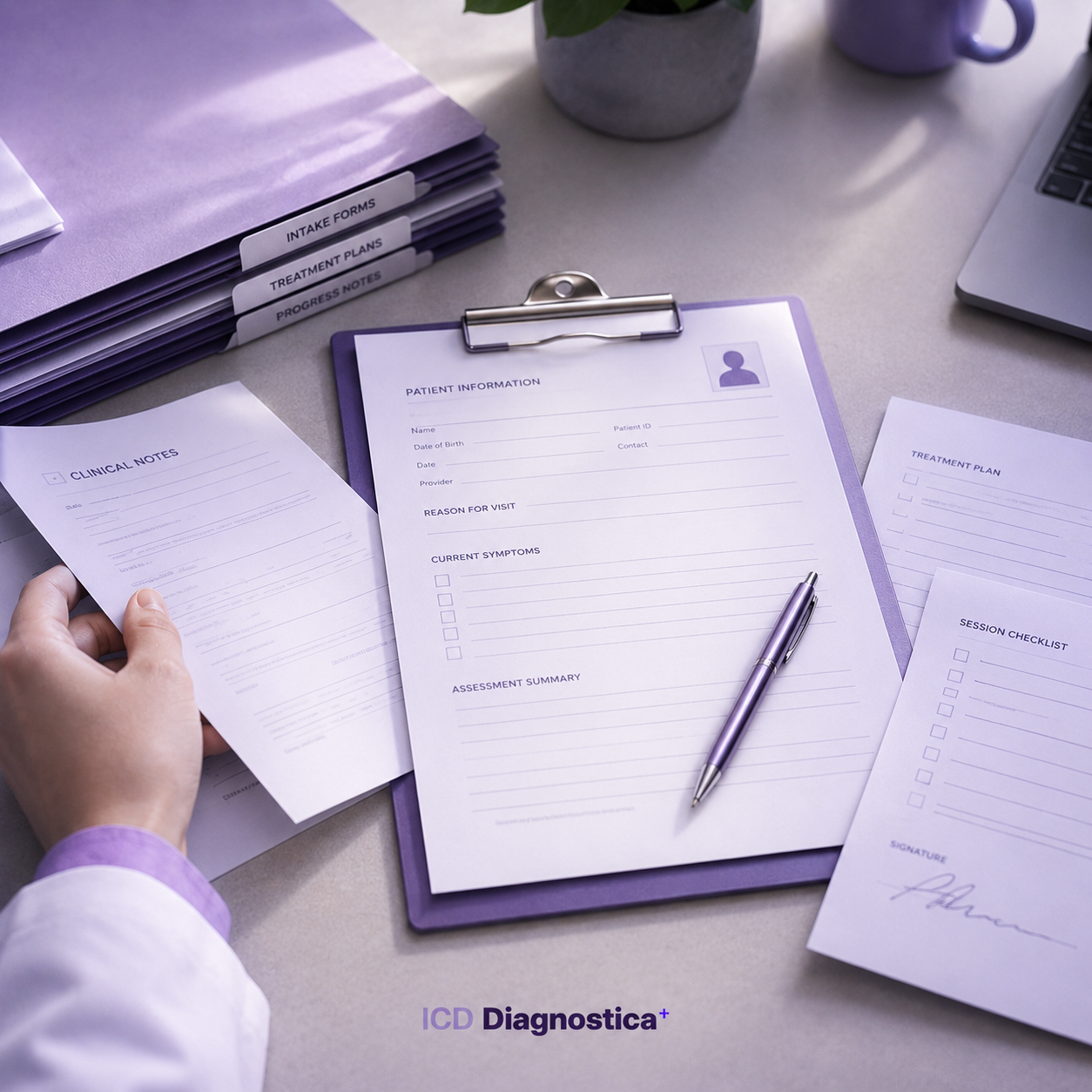
In practice, a psychologist may keep different types of documentation depending on where they work and how services are provided. This distinction is not only formal; it affects retention time, disclosure rules, the scope of information that should be recorded, and who may access the documentation.[3]
Medical documentation mainly concerns situations in which the psychologist works within an entity performing medical activity, such as a mental health clinic, hospital, psychological clinic operating as a medical entity, or another facility providing health services. In that setting, the psychologist's documentation may form part of the patient's medical records and be subject to the Patients' Rights Act. As a rule, medical documentation is retained for 20 years from the end of the calendar year in which the last entry was made.[4]
Psychological documentation is a category expressly regulated in the new Psychologist Profession Act. The Act provides for an obligation to keep psychological documentation of the recipient of psychological services and states that this documentation is covered by professional secrecy. This model will generally apply from 2028, so at present the current legal position should be clearly distinguished from the forthcoming rules.
Educational and counselling documentation concerns psychologists working in schools, pre-schools and public educational psychology centres. Its basis is not medical documentation law, but educational regulations. The Ministry of Education indicates that support provided by a public educational psychology centre is voluntary and free of charge, and that assessment, information on assessment results and opinions are issued at the request of a parent or an adult student.
The key conclusion is simple: not every psychologist's documentation is medical documentation. Its character depends on whether the psychologist works in a medical entity, provides psychological services outside the healthcare system, or works within education.
Legal position in 2026: old act, new act and the transitional period
In 2026, two orders must be distinguished: the current legal position and the provisions of the new Act that will apply later. The Ministry of Family, Labour and Social Policy states that the new Psychologist Profession Act was signed on 12 February 2026, but as a rule it enters into force 2 years and 3 months after promulgation, that is on 19 May 2028.
This means that in 2026 the new solutions cannot yet be treated as fully binding. This especially concerns psychological documentation, the professional self-government of psychologists, and the new model for confirming the right to practise. The article should therefore consistently distinguish statements such as “currently in force” from “the new Act provides” or “from 2028 the rule will be”.
When is a psychologist's documentation medical documentation?
A psychologist's documentation is medical documentation mainly when it is created in connection with health services provided in a medical entity. This may include a mental health clinic, hospital ward, psychological clinic operating as a medical entity, or another facility that keeps patient records under medical rules.
In such cases, the psychologist's documentation is subject to the rules applicable to medical documentation, including retention and disclosure rules under the Patients' Rights Act. The general rule is retention for 20 years from the end of the calendar year in which the last entry was made, although the Act also provides specific exceptions for certain types of documentation.
This does not mean that every document created by a psychologist automatically becomes medical documentation. If the psychologist works outside a medical entity, for example in a private psychological practice that is not medical activity, in a school or in an educational psychology centre, the legal basis may be different.
Psychological documentation under the new Act
The new Psychologist Profession Act introduces a clear category of psychological documentation. Under its model, a psychologist will be obliged to keep documentation of the recipient of psychological services, and that documentation will be covered by professional secrecy. This is an important change because it brings order to an area that has long been ambiguous in practice.
Psychological documentation should not be understood as a transcript of a session or a full record of everything said by the person receiving the service. Its purpose is to document the fact, scope and character of the service in a reliable way. It should be specific, concise and understandable later, but should not contain excessive private information irrelevant to the purpose of documentation.
In practice, the psychologist should record who used the service, when it was provided, its general purpose, the character of the intervention, the key findings and whether any safety issues appeared. Documentation should protect both the interests of the person receiving the service and the psychologist's professional responsibility.
How long should documentation be retained: 5 years or 20 years?
There is no single universal retention period for every type of psychologist documentation. This is one of the most important points to explain clearly.
If the psychologist's documentation forms part of medical documentation, the general rule is 20 years from the end of the calendar year in which the last entry was made. This follows from the Patients' Rights Act.
If the documentation is psychological documentation under the new Psychologist Profession Act, the rules provided in that Act should be applied after it enters into force. The article should nevertheless make clear that this is a forthcoming solution, not one fully binding already in 2026.
Practical conclusion: 20 years does not automatically apply to every psychologist's documentation, but it does apply to medical documentation kept in the context of health services. Psychological documentation under the new Act will function as a separate legal category with its own retention and disclosure rules.
Psychologist documentation in schools and educational psychology centres
A psychologist working in a school, pre-school or public educational psychology centre operates in a different setting from a psychologist in a medical entity. Documentation kept in this area should not automatically be equated with medical documentation. Its basis is educational regulation, and its purpose is linked to psychological and pedagogical support, educational assessment, opinions, decisions and supporting the student in school functioning.
The Ministry of Education indicates that assessment in a centre, issuing information about assessment results and issuing an opinion take place at the request of a parent or adult student. Forwarding an opinion to a school also takes place at the request of a parent or adult student. This distinguishes counselling centre documentation from medical documentation, where different legal bases and disclosure routes apply.
Educational documentation may contain very sensitive data and therefore requires a high level of confidentiality. That does not change the fact that its legal character differs from medical documentation and from psychological documentation under the new Act.
Personal data protection, GDPR and professional secrecy
Psychologist documentation contains particularly sensitive information: mental health, emotions, relationships, life history, family difficulties, and social, educational or occupational functioning. In many cases it also contains information about third parties. For that reason, documentation should follow the principles of confidentiality, data minimisation and adequacy to its purpose.
In practice, documentation security is not limited to a password on a file. It covers the whole organisation of work: storage of paper documents, computer security, limiting access by unauthorised people, backup control, secure destruction of documents and caution when using private messengers or unsecured notes.
It is worth noting that the Polish Data Protection Authority has approved codes of conduct concerning data protection in the health sector, including the Code of Conduct for the Healthcare Sector approved in 2023. This is not automatically a code for every psychological practice, but it is an important reference point for data security standards in health-related contexts.
How to write psychological documentation professionally?
Good psychological documentation should be specific, concise and understandable later. It should separate facts, the person's statements, the psychologist's observations and clinical hypotheses. It is worth writing as if the documentation may one day be disclosed to an authorised person or assessed in a formal context, while still respecting the dignity and privacy of the person receiving the service.
It is better to avoid value judgments such as: “the patient manipulates”, “is difficult”, “exaggerates”. Descriptive notes referring to observable behaviour and reported difficulties are safer and more professional.
The patient reports strong tension in family relationships. During the conversation, they repeatedly returned to feeling misunderstood by close relatives. Marked emotional reactivity was visible when discussing the conflict with the mother.
Example of a neutral clinical noteThis is more neutral, clinical and useful than: “The patient is hysterical and manipulates the family.” Professional documentation should be specific enough to reconstruct the meaning of the service provided, but should not become a collection of excessive, private or judgmental information.
Most common errors in psychologist documentation
Common errors include calling every type of psychologist documentation medical documentation, regardless of the workplace and legal basis. Another error is automatically applying the 20-year period to all documentation, even though that rule concerns medical documentation rather than every form of documenting psychological work.
Another problem is treating test sheets, working notes and diagnostic materials as ordinary documents intended for full disclosure. In practice, test materials require particular protection because disclosure may violate the rules for using diagnostic tools and reduce their psychometric value.
Other errors include recording too many private details, mixing facts with interpretations, using judgmental language and storing documentation in unsecured files, private messengers or loose notes. A separate risk is disclosing information to family, school, employer or other people without the proper legal basis.
In the context of the new Act, one more error should be added: describing the 2026 provisions as if they were already fully in force. It is more accurate to state that the new Act has been enacted and published, but that its principal provisions enter into force only on 19 May 2028.
Summary
Psychologist documentation in Poland requires distinguishing several legal orders. Medical documentation mainly concerns work in medical entities and follows the rules applicable to patient records. Psychological documentation will be expressly regulated by the new Psychologist Profession Act, whose principal provisions enter into force in 2028. Educational and counselling documentation functions under a separate system of rules concerning psychological and pedagogical support.
The key question is therefore not simply whether a psychologist “keeps documentation”, but what type of documentation it is, where it is created, on what legal basis and to whom it may be disclosed. This distinction protects both the person receiving services and the psychologist responsible for keeping documentation reliably, securely and lawfully.
Frequently asked questions
Is every psychologist's documentation medical documentation?
When do the new rules on the psychologist profession enter into force?
When is a psychologist's documentation medical documentation?
Should psychologist documentation be retained for 5 years or 20 years?
Is school psychologist documentation medical documentation?
How should psychological documentation be written professionally?
Legal basis and sources
- Act of 23 January 2026 on the Profession of Psychologist and the Professional Self-Government of Psychologists, Dz.U. 2026 pos. 187.
- Act of 6 November 2008 on Patients' Rights and the Patients' Rights Ombudsman (consolidated text Dz.U. 2024 pos. 581).
- Regulation of the Minister of Health of 6 April 2020 on the types, scope and templates of medical records and the manner of their processing, Dz.U. 2020 pos. 666.
- Ministry of Family and Social Policy. (2026). Profession of psychologist – information and rules. Gov.pl. gov.pl
- Patients' Rights Ombudsman. Legal explanations on medical documentation. gov.pl/rpp
- pacjent.gov.pl. Patient data protection. pacjent.gov.pl
- Personal Data Protection Authority (UODO). Approved codes of conduct – healthcare sector. uodo.gov.pl
- Ministry of Education. Psychological and pedagogical guidance. gov.pl/edukacja
- Regulation of the Minister of National Education of 1 February 2013 on the detailed rules of operation of public educational psychology centres, Dz.U. 2013 pos. 199.
- Regulation of the Minister of National Education of 9 August 2017 on the principles of organisation and provision of psychological and pedagogical assistance in public pre-schools, schools and facilities, Dz.U. 2017 pos. 1591.
This article is for information only and does not constitute legal advice. Legal position as of May 2026. In case of doubt consult a lawyer or a Data Protection Officer.
← All articles